
The EJRTCA Breed Standard shall serve three purposes:
- To set ideal, attainable goals for the breeder.
- To guide the judge.
- To guide buyers in finding correct or acceptable specimens of the breed.
In the registration process, the terrier, if accepted by the EJRTCA Registration Committee, will be assigned to one of these categories.
Advanced – The dog meets or exceeds all EJRTCA Breed Standards and processes a three-level pedigree -OR- has progressed from the “Tentative” category based on show and/or trial performance.
Tentative – The dog conforms to EJRTCA Breed Standards but does not process a three -level pedigree. Can progress to “Advanced” based on written application to the EJRTCA Registration Committee detailing accomplishments in show and/or trial performance.
Pet Quality – Reserved for dogs which generally meet EJRTCA Breed Standards but are deemed not to be of breeding quality or which have been spayed or neutered. (Typically, might include dogs with severe over/under bite, dwarfism, exaggerated shyness/aggressiveness, etc.)
EJRTCA Conformation Standards
General Appearance
A strong, active, little working Terrier of great character with flexible body of medium length. His smart movement matches his keen expression. Tail docking is optional and the coat may be smooth, rough or broken.
Characteristics
A lively, alert and active Terrier with a keen, intelligent expression.
Temperament
Bold and fearless, friendly but quietly confident.
Height
The height of the terrier shall be between 8 and 12 inches as measured at the withers with the dog standing fully erect.
Body
Sturdy, balanced terrier. Body length slightly longer than length of leg. Length should not exceed function. Straight back, level, with high tail set carried erect. Chest should be spanned by two hands behind the shoulder blades. Chest deep rather than wide, with good clearance and the brisket located at the height mid-way between the ground and the withers. The rear should be well put together with strong muscle and good angulations. Well laid back shoulder.
Neck
Well laid into shoulder. Strong and clean allowing head to be carried with poise.
Head
Strong boned with powerful jaws and strong cheek muscles. Dark almond-shaped eyes, pigmented eye rims, dark black pigment on nose. Small, v-shaped ears carried close to the head. Prick, semi-prick and rose ears are acceptable but not preferred.
Eyes
Small dark and with keen expression. MUST not be prominent and eyelids should fit closely. The eyelid rims should be pigmented black. Almond shape.
Ears
Button or dropped of good texture and great mobility.
Mouth & Teeth
The points of the upper incisors slightly overlapping the lower. May be missing up to four teeth. Deep wide and powerful jaws with tight-fitting pigmented lips and strong teeth closing to a scissor bite.
Legs
Straight as is consistent with the short legs for which we aim.
Feet
“Hound-Like, “Fox-Like” and “Hare-Like” are all acceptable. All three are considered sound working feet for a Jack Russell. Round, hard, padded, not large, toes moderately arched, turned neither in nor out.
Tail
May droop at rest. When moving should be erect and if docked the tip should be on the same level as ears.
Gait/Movement
True, free, lively, springy, well-coordinated.
Coat
Smooth, rough or broken coats, without coat being wooly. Smooth should not be sparse. Belly and underside coated. Must be weatherproof, preferably unaltered.
Color
Predominantly white with tan, black or brown markings. The tan markings can be from the lightest tan to the richest tan (chestnut). Ticked or mottled acceptable. Brindle not acceptable.
Faults
Any departure from the foregoing points should be considered a fault and the seriousness with which the fault should be regarded should be in exact proportion to its degree. However, the following weaknesses should be particularly penalized:
- Lack of true Terrier characteristics – Nervousness, cowardice, over-aggressiveness.
- Lack of balance, i.e. over exaggeration of any points.
- Sluggish or unsound movement.
- Faulty mouth, week bite, minor physical deformities.
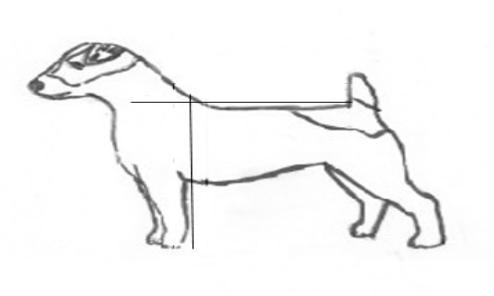
The picture is only provided as to show where a dog should be measured, not how a dog should look.